“Nobody’s Coming to Save You!”
One of the worst things I have seen parents do is make their children co-dependent.
When I was a preschool teacher, I was often seen as being too strict. The parents who were dissatisfied with me were usually the ones who wanted to keep their child a baby and immature for as long as possible. I remember one mother becoming upset with me because she wanted to pack a bottle into her child’s bag. I had to explain to her that while she was free to do whatever she wished at home, in my classroom the children would be learning independent skills — drinking from a cup, potty training, cleaning up after themselves, and other age-appropriate responsibilities.
Do all parents wish their children could stay little forever? Of course. There is something bittersweet about watching tiny hands grow larger and little voices mature. But the reality is that every second of every day, your child is growing — not only physically, but mentally and emotionally as well.
What I often discovered in those situations was that the immature one was not the child, but the parent.
Children naturally want to explore. They have an innate desire to try new things, push boundaries, and discover the world around them. That is why parents spend half their younger years saying, “Be careful!” while simultaneously teaching them how to navigate life on their own.
Some parents unknowingly cripple their children emotionally because they need to feel needed. They solve every problem, remove every obstacle, and rescue them from every discomfort. But one of the hardest truths in life is this:
At some point, nobody is coming to save you.
There comes a day when every person must learn how to stand on their own two feet, make decisions, recover from failure, and face life without someone constantly cushioning every fall. If a child never learns resilience early, adulthood becomes an overwhelming shock.
This truth has become even more meaningful to me as I watch it lived out in my own family.
I applauded my oldest daughter recently concerning my four grandchildren, and I also observe her parenting her five-year-old bonus child through remarriage. These are children who already show remarkable resilience. I marvel at their ability to articulate their thoughts on various subjects, and at their natural desire for financial independence even at such young ages. They do not resist responsibility — in fact, they lean into it.
These kids absolutely do not mind working to fund their needs and wants. Hard work is being built into them as a normal part of life, not an optional one.
Their mother, Winter, said something to me that stuck: “Nope, I had to make sure they knew that no one is coming to save them!”
That mindset is shaping something strong in them.
These children are not being raised to expect someone to ride in on a horse and rescue them from the consequences of foolish decisions or immaturity. Friendships and acquaintances have their proper place, but they are not a financial plan, nor are they a substitute for personal responsibility. They are being taught early to position themselves in life, to think strategically, and to make decisions with awareness that their future stability will depend on what they build, not what they borrow.
My father used to say, “Plan for a rainy day.” And he was right. One thing about life is that it will rain at some point, whether we want it to or not. Wisdom is not avoiding storms — it is preparing before they come.
We must raise children not only to respond to the unexpected, but to anticipate it. To understand that stability is built through discipline, consistency, and foresight.
My youngest daughter, Faith, embodies this in her own way. She is diligent about her budget ledger and intentional in her financial planning. She has developed a sound financial strategy that would make an accountant proud. She has no interest in living on what she calls the “struggle bus,” and she works steadily to avoid it.
There is something grounding about watching that kind of discipline take root early. It is not just about money — it is about mindset. It is about learning that security is built, not assumed.
In a time when financial uncertainty seems to weigh heavily on so many, it is easy for peace to feel fragile. People often place their security in systems, markets, or outcomes they hope will remain stable. When those expectations are shaken—through economic shifts, job uncertainty, or changing financial landscapes—it can leave people anxious and unsettled.
In that space, it becomes harder to discern what is truth, what is fear, and what actually matters long-term. Joy can slowly get consumed by worry.
But Scripture has already spoken wisdom into this very human struggle:
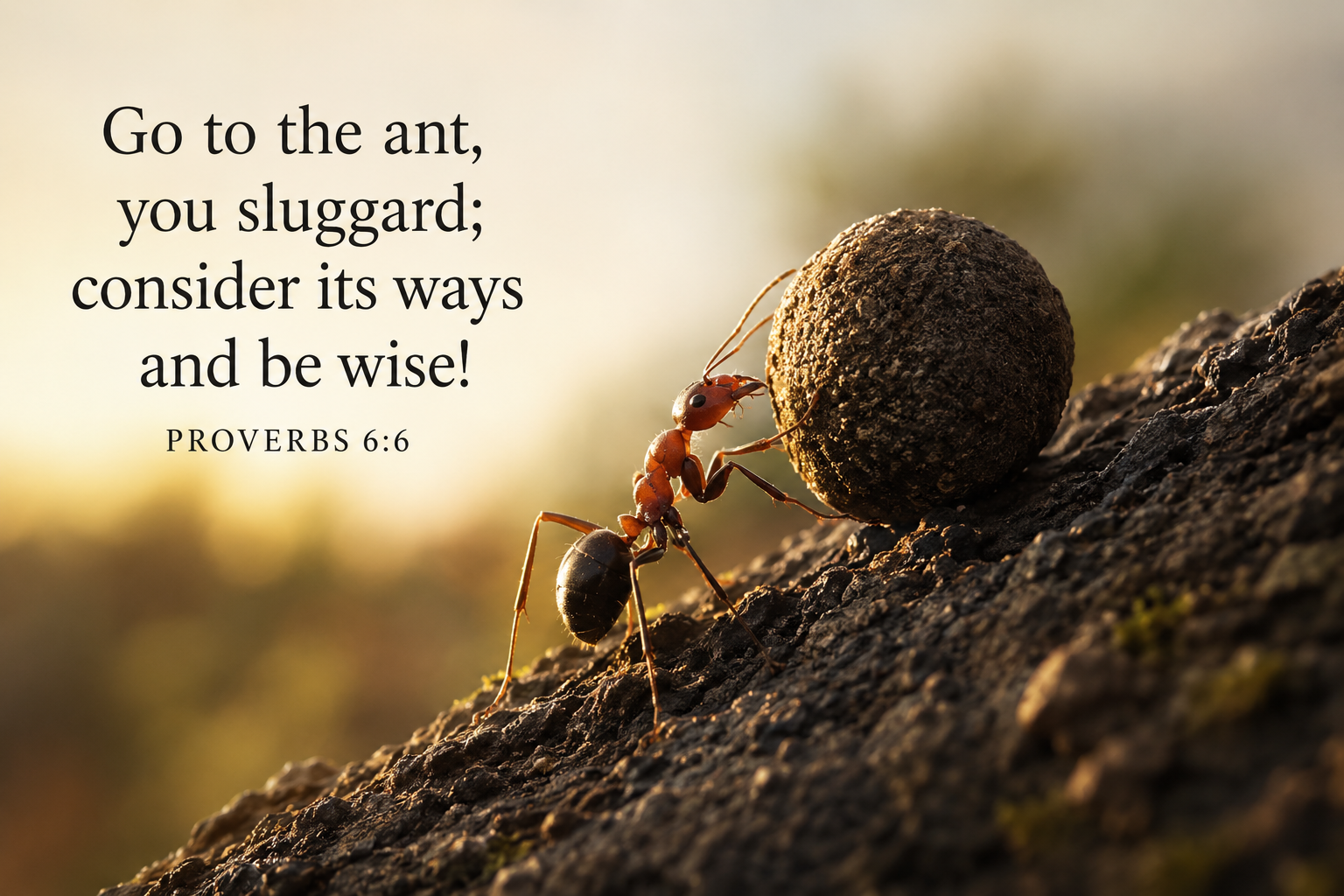
“Go to the ant, you sluggard; consider its ways and be wise!” — Proverbs 6:6
The ant does not wait for crisis to think about preparation. It works steadily in seasons of plenty so it is not overcome in seasons of lack. It understands something essential: life has seasons, and wisdom prepares ahead of time.
The ant teaches us that discipline is not fear—it is foresight. And preparation is not anxiety—it is peace in motion.
In a world where so much feels uncertain, perhaps the real question is not what is happening around us, but what we have been building within us.
Because when external systems shift, internal stability is what holds a person steady.
And ultimately, peace was never meant to be rooted in anything fragile or temporary. It is anchored in wisdom, discipline, and trust that is deeper than circumstances.
Like the ant, we are invited to live with foresight, not panic. With preparation, not fear. With wisdom, not dependence on unstable ground.
Because storms are not a possibility—they are a certainty.
And nobody is coming to save us from building the life we are responsible to build.
